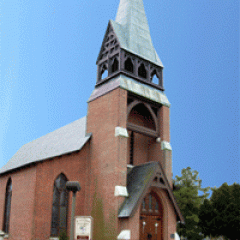
St. Paul’s Episcopal Church (Georgetown, Delaware)

St. Paul’s Protestant Episcopal Church is really a historic Episcopal church found at 122 East Pine Street in Georgetown, Sussex County. The congregation began in 1794 however this brick building was finished in 1844. It had been remodeled in 1881 by McKim Mead and White-colored of recent You are able to City in early Victorian Medieval style. This is among the 38 parish places of worship from the Episcopal Diocese of Delaware, which is on the National Register of Historic Places. Many statesmen from Sussex County are interred within the churchyard, including Caleb R. Layton, Daniel J. Layton, Charles C. Stockley yet others.
The congregation was organized on June 21, 1794 right after the American Revolutionary War, following the Anglican Church was disestablished within the U . s . States and also the Episcopal Church began. The audience acquired a stretch of land on Front and Pine roads, although it never was used and offered in 1806. Even without the a church structure, the Rev. James Wiltbank conducted services infrequently in the courtroom house. In 1804 the congregation acquired the present lot at East Pine and Academy roads. They built a wood-frame structure within the next 2 decades.
In 1805 the Delaware legislature passed an action allowing this vestry to boost $1500 by lottery for the making of the church. New congregations were finding out how to support their parishes. A wood church was built as well as on The month of january 25, 1806, the Rev. Hamilton Bell dedicated it, though it wasn’t complete. The legislature approved another lottery in 1827 to boost $10,000 for the making of an academy along with a Masonic Hall in Georgetown, and for the conclusion of St. Paul’s. This lottery never was held.
In 1843 the frame church was taken off the website and construction of the new brick church started. This structure was finished in 1844 and consecrated on November 19 of the identical year. By 1881 after nearly 4 decades, the church had fallen into relative disrepair. It had been renovated and remodeled in early Victorian Medieval style, through the architectural firm of McKim, Mead, and White-colored of recent You are able to City, distinguished across the country for designing numerous notable places of worship. It’s been maintained in this fashion.
Rev. James C. Kerr showed up in 1885 and installed the church’s first pipe organ. The year after a Sunday School chapel was organized along with a building for this was built within the 1870s. Finally in 1897 the complex was finished with a 29′ by 43′ two-story frame rectory, built on adjacent property by John W. Messick for the sum of the $1500. The Rev. John Warnock was the very first rector to reside in the rectory.
In 1930 U.S. Senator Willard Saulsbury, Junior. bequeathed St. Paul’s funds to commission a stained-glass altar window the job is called “The Te Deum Window,” depicting the belief from the Church as mentioned within the creed-anthem “The Te Deum.” Your window was created by James H. Hogan from the London studios of James Powell & Sons. It had been dedicated Feb 9, 1930 through the bishop.
The Nation’s Register of Historic Places added the church to the list in 1979. Later a fireplace of the unknown origin destroyed the parish hall, Sunday School classrooms and sacristy, although the sanctuary and nave weren’t broken. These parts were subsequently reconstructed in 1990.
The next data generally originates from tombstones within the churchyard, where some dates are unreadable. Missing dates happen to be shown by question marks. In instances where only a few figures are legible, underscores represent the missing number. Titles, positions and the relationship has been incorporated to differentiate individuals with similar or identical names and provide more information.
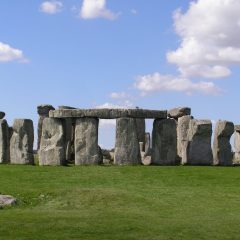
Stonehenge

Image by/from garethwiscombe
Stonehenge is really a prehistoric monument in Wiltshire, England, two miles (3 km) west of Amesbury. It includes a ring of standing gemstones, each around 13 ft (4.0 m) high, seven ft (2.1 m) wide, and weighing around 25 tons. The gemstones are positioned within earthworks in the center of probably the most dense complex of Neolithic and Bronze Age monuments in England, including hundreds of tumuli (funeral mounds).
Archaeologists accept is as true was built from 3000 BC to 2000 BC. The nearby circular earth bank and ditch, which constitute the first phase from the monument, happen to be dated to around 3100 BC. Radiocarbon dating shows that the very first bluestones were elevated between 2400 and 2200 BC, although they’ve already been to begin as soon as 3000 BC.
Probably the most famous landmarks within the Uk, Stonehenge is considered like a British cultural icon. It’s been a legally protected Scheduled Ancient Monument since 1882, when legislation to safeguard historic monuments was initially effectively introduced in great britan. The website and it is surroundings were put into UNESCO’s listing of World Heritage Sites in 1986. Stonehenge is a member of the Crown and managed by British Heritage the nearby land is a member of the nation’s Trust.
Stonehenge might have been a funeral ground from the earliest beginnings. Deposits that contains human bone date from as soon as 3000 BC, once the ditch and bank were first dug, and ongoing not less than another five centuries.
The Oxford British Dictionary cites Alfric’s tenth-century reference, by which henge-high cliff is offered this is “precipice”, or stone thus, the stanenges or Stanheng “near Salisbury” recorded by eleventh-century authors are “gemstones supported in mid-air”. In 1740 William Stukeley notes, “Pendulous rocks are actually known as henges in Yorkshire…I doubt not, Stonehenge in Saxon signifies the hanging gemstones.” Christopher Chippindale’s Stonehenge Complete provides the derivation from the name Stonehenge as from the Old British words stan meaning “stone”, and only hencg meaning “hinge” (since the stone lintels hinge around the upright gemstones) or hen(c)en meaning “to hold” or “gallows” or “instrument of torture” (though elsewhere in the book, Chippindale cites the “suspended gemstones” etymology). Like Stonehenge’s trilithons, medieval gallows contained two uprights having a lintel joining them, as opposed to the inverted L-shape more familiar today.
The “henge” portion has provided its name to some type of monuments referred to as henges. Archaeologists define henges as earthworks composed of the circular banked enclosure by having an internal ditch. As frequently occur in archaeological terminology, this can be a holdover from antiquarian use. Because its bank is inside its ditch, Stonehenge isn’t a classic henge site.
Despite being contemporary with true Neolithic henges and stone circles, Stonehenge is in lots of ways atypical—for example, at greater than 24 ft (7.3 m) tall, its extant trilithons’ lintels, locked in place with mortise and tenon joints, allow it to be unique.
Mike Parker Pearson, leader from the Stonehenge Riverside Project based at Durrington Walls, noted that Stonehenge seems to possess been connected with funeral in the earliest duration of its existence:
Stonehenge would be a host to funeral from the starting to its zenith within the mid third millennium B.C. The cremation funeral dating to Stonehenge’s sarsen gemstones phase is probably one of many out of this later duration of the monument’s use and demonstrates it had become still greatly a website from the dead.
Stonehenge evolved in a number of construction phases spanning a minimum of 1500 years. There’s proof of large-scale construction on and round the monument that possibly extends the landscape’s time period to 6500 years. Dating and comprehending the various phases of activity are complicated by disturbance from the natural chalk by periglacial effects and animal burrowing, low quality early excavation records, and too little accurate, scientifically verified dates. The current phasing most generally decided to by archaeologists is detailed below. Features pointed out within the text are numbered and proven of the routine, right.
Archaeologists have discovered four, or even five, large Mesolithic postholes (one might have been an all natural tree throw), which date close to 8000 BC, underneath the nearby old tourist vehicle-park being used until 2013. These held pine posts around two feet six inches (.75 m) across, that have been erected and finally rotted in situ. Three from the posts (and perhaps four) were within an east-west alignment who have had ritual significance. Another Mesolithic astronomical site in great britan may be the Warren Field site in Aberdeenshire, which is the world’s earliest Lunar calendar, remedied yearly by observing the midwinter solstice. Similar but later sites have been discovered in Scandinavia. Funds that might have been contemporaneous using the posts has been discovered at Blick Mead, a dependable year-round spring one mile (1.6 km) from Stonehenge.
Salisbury Plain ended up being still wooded, but 4,000 years later, throughout the earlier Neolithic, people built a causewayed enclosure at Robin Hood’s Ball and lengthy barrow tombs within the surrounding landscape. In roughly 3500 BC, a Stonehenge Cursus was built 2,300 ft (700 m) north from the site because the first maqui berry farmers started to obvious the trees and get the area. Many other formerly overlooked stone or wooden structures and funeral mounds may date dating back to 4000 BC. Charcoal in the ‘Blick Mead’ camp 1.5 miles (2.4 km) from Stonehenge (close to the Vespasian’s Camp site) continues to be dated to 4000 BC. The College of Buckingham’s Humanities Research Institute believes the community who built Stonehenge resided here during a period of several millennia, which makes it potentially “among the pivotal places within the good reputation for the Stonehenge landscape.”
The very first monument contained a circular bank and ditch enclosure made recently Cretaceous (Santonian Age) Seaford Chalk, calculating about 360 ft (110 m) across, having a large entrance towards the north east along with a smaller sized one towards the south. It was in open grassland on the slightly sloping place. The builders placed the bones of deer and oxen towards the bottom from the ditch, plus some labored flint tools. The bones were significantly over the age of the antler picks accustomed to dig the ditch, and those who hidden them had cared for them for a while just before funeral. The ditch was continuous but have been dug in sections, such as the ditches from the earlier causewayed enclosures in the region. The chalk dug in the ditch was stacked as much as make up the bank. This primary stage is dated close to 3100 BC, then the ditch started to silt up naturally. Inside the periphery from the enclosed area is really a circle of 56 pits, each about 3.3 ft (1 m) across, referred to as Aubrey holes after John Aubrey, the seventeenth-century antiquarian who had been considered to have first identified them. The pits might have contained standing timbers developing a timber circle, although there’s no excavated proof of them. A current excavation has recommended the Aubrey Holes might have initially been accustomed to erect a bluestone circle. If the were the situation, it might advance the first known stone structure in the monument by a few five centuries. A little outer bank past the ditch may also date for this period.
In 2013 a group of archaeologists, brought by Mike Parker Pearson, excavated greater than 50,000 cremated bone tissue, from 63 individuals, hidden at Stonehenge. These remains had initially been hidden individually within the Aubrey holes, exhumed throughout a previous excavation conducted by William Hawley in 1920, been considered trivial by him, and subsequently re-interred together in a single hole, Aubrey Hole 7, in 1935. Physical and chemical research into the remains has proven the cremated were almost equally women and men, and incorporated some children. Because there was proof of the actual chalk underneath the graves being crushed by substantial weight, they figured that the very first bluestones introduced from Wales were most likely utilized as grave markers. Radiocarbon dating from the remains has place the date from the site five centuries sooner than formerly believed, close to 3000 BC. A 2018 study from the strontium content from the bones found that lots of people hidden there at about the time of construction had most likely originate from close to the supply of the bluestone in Wales coupled with not extensively resided in Stonehenge before dying.
Proof of the 2nd phase is not visible. The amount of postholes dating towards the early third millennium BC shows that some type of timber structure was built inside the enclosure during this time period. Further standing timbers were placed in the northeast entrance, along with a parallel alignment of posts ran inwards in the southern entrance. The postholes are smaller sized compared to Aubrey Holes, being only around 16 inches (.4 m) across, and therefore are significantly less regularly spaced. The financial institution was intentionally reduced tall and also the ditch ongoing to silt up. A minimum of twenty-five from the Aubrey Holes has contained later, intrusive, cremation burials dating towards the 220 years following the monument’s beginning. It appears that regardless of the holes’ initial function, it altered to become funerary one during Phase two. Thirty further cremations were put into the enclosure’s ditch and also at other points inside the monument, mostly within the eastern half. Stonehenge thus remains construed as functioning being an enclosed cremation graveyard at the moment, the first known cremation graveyard within the Uk. Fragments of unburnt human bone are also based in the ditch-fill. Dating evidence is supplied through the late Neolithic grooved ware pottery that’s been found regarding the the characteristics out of this phase.
Archaeological excavation has established that around 2600 BC, the builders abandoned timber towards stone and dug two concentric arrays of holes (the Q and R Holes) within the center from the site. These stone sockets are just partially known (hence on present evidence are occasionally referred to as developing ‘crescents’) however, they may be the remains of the double ring. Again, there’s little firm dating evidence with this phase. The holes organized to 80 standing gemstones (proven blue of the routine), only 43 of which may be tracked today. It’s generally recognized the bluestones (most of which are constructed with dolerite, an igneous rock), were transported through the builders in the Preseli Hillsides, 150 miles (240 km) away in modern-day Pembrokeshire in Wales. Another theory is they were introduced much closer to the website as glacial erratics through the Irish Ocean Glacier although there’s no proof of glacial deposition within southern central England. A 2019 publication announced that proof of Megalithic quarrying have been available at quarries in Wales recognized as an origin of Stonehenge’s bluestone, indicating the bluestone was quarried by human agency and never transported by glacial action.
The lengthy-distance human transport theory was bolstered this year through the discovery of the megalithic bluestone quarry at Craig Rhos-y-felin, near Crymych in Pembrokeshire, the probably spot for a few of the gemstones to possess been acquired. Other standing gemstones might happen to be small sarsens (sandstone), used later as lintels. The gemstones, which considered about two tons, might have been moved by lifting and transporting them on rows of rods and rectangular frameworks of rods, as recorded in China, Japan and India. It’s not known if the gemstones were taken from their quarries to Salisbury Plain or were caused by removing a venerated stone circle from Preseli to Salisbury Plain to “merge two sacred centres into one, to unify two politically separate regions, in order to legitimise the ancestral identity of migrants moving in one region to a different”. Each monolith measures around 6.6 ft (2 m) tall, between 3.3 and 4.9 ft (1 and 1.5 m) wide and around 2.6 ft (.8 m) thick. That which was to get referred to as Altar Stone is nearly certainly produced from the Senni Beds, possibly from 50 miles (80 kilometres) east of Mynydd Preseli within the Brecon Beacons.
Its northern border-eastern entrance was widened at the moment, which means that it precisely matched the direction from the midsummer sunrise and midwinter sunset from the period. This phase from the monument was abandoned incomplete, nevertheless the small standing gemstones were apparently removed and also the Q and R holes purposefully backfilled. Nevertheless, the monument seems to possess eclipsed the website at Avebury in importance for the finish of the phase.
The Heelstone, a Tertiary sandstone, might also happen to be erected outdoors its northern border-eastern entrance during this time period. It can’t be precisely dated and might have been installed anytime during phase 3. Initially, it had been supported with a second stone, which is not visible. Two, or even three, large portal gemstones were setup just within the north-eastern entrance, which just one, the fallen Slaughter Stone, 16 ft (4.9 m) lengthy, now remains. Additional features, loosely dated to phase 3, range from the four Station Gemstones, a couple of which was atop mounds. The mounds are classified as “barrows” although they don’t contain burials. Stonehenge Avenue, a parallel set of ditches and banks leading two miles (3 km) towards the River Avon, seemed to be added. Two ditches much like Heelstone Ditch circling the Heelstone (that was at that time reduced one monolith) were later dug round the Station Gemstones.
Throughout the next major phase of activity, 30 enormous Oligocene-Miocene sarsen gemstones (proven gray of the routine) were introduced towards the site. They’ve already originate from a quarry around 25 miles (40 km) north of Stonehenge around the Marlborough Downs, or they’ve already been collected from the “litter” of sarsens around the chalk downs, nearer to hands. The gemstones were outfitted and made with mortise and tenon joints before 30 were erected like a 108-feet (33 m) diameter circle of standing gemstones, having a ring of 30 lintel gemstones resting on the top. The lintels were suited to each other using another woodworking method, the tongue and groove joint. Each standing stone was around 13 ft (4.1 m) high, 6.9 ft (2.1 m) wide and considered around 25 tons. Each had clearly been labored using the final visual effect in your mind the orthostats widen slightly at the pinnacle so that their perspective remains constant when viewed in the ground, as the lintel gemstones curve slightly to carry on the circular appearance from the earlier monument.
The inward-facing surfaces from the gemstones are smoother and much more finely labored compared to outer surfaces. The typical thickness from the gemstones is 3.6 ft (1.1 m) and also the average distance together is 3.3 ft (1 m). As many as 75 gemstones could have been required to complete the circle (60 gemstones) and also the trilithon horseshoe (15 gemstones). It had been thought the ring may have been left incomplete, but an extremely dry summer time in 2013 revealed patches of parched grass which might match the place of removed sarsens. The lintel gemstones are each around 10 ft (3.2 m) lengthy, 3.3 ft (1 m) wide and a pair of.six ft (.8 m) thick. The tops from the lintels are 16 ft (4.9 m) over the ground.In this particular circle was five trilithons of outfitted sarsen stone arranged inside a horseshoe shape 45 ft (13.7 m) across, using its open finish facing northeast. These huge gemstones, ten uprights and five lintels, consider to 50 tons each. These were linked using complex jointing. They’re arranged symmetrically. The tiniest set of trilithons were around 20 ft (6 m) tall, the following pair just a little greater, and also the largest, single trilithon within the south-west corner could have been 24 ft (7.3 m) tall. Just one upright in the Great Trilithon still stands, which 22 ft (6.7 m) is seen along with a further 7.9 ft (2.4 m) is underground. The pictures of the ‘dagger’ and 14 ‘axeheads’ happen to be created on among the sarsens, referred to as stone 53 further carvings of axeheads result around the outer faces of gemstones 3, 4, and 5. The carvings take time and effort up to now but they are morphologically much like late Bronze Age weapons. Early 21st-century laser checking from the carvings supports this interpretation. The happy couple of trilithons within the north east are tiniest, calculating around 20 ft (6 m) tall the biggest, which is incorporated in the south-west from the horseshoe, is nearly 25 ft (7.5 m) tall.[dubious – discuss]
This ambitious phase continues to be radiocarbon dated to between 2600 and 2400 BC, slightly sooner than the Stonehenge Archer, discovered within the outer ditch from the monument in 1978, and also the two teams of burials, referred to as Amesbury Archer and also the Boscombe Bowmen, discovered three miles (5 km) towards the west. Analysis of animal teeth found two miles (3 km) away at Durrington Walls, thought by Parker Pearson is the ‘builders camp’, shows that, during some period between 2600 and 2400 BC, as much as 4,000 people collected to begin for that mid-winter and mid-summer time festivals evidence demonstrated the creatures have been slaughtered around nine several weeks or 15 several weeks after their spring birth. Strontium isotope research into the animal teeth demonstrated that some have been introduced from as far afield because the Scottish Highlands for that celebrations. At comparable time, a sizable timber circle an additional avenue were built at Durrington Walls overlooking the forest Avon. The timber circle was oriented for the rising Sun around the midwinter solstice, opposing the solar alignments at Stonehenge. The avenue was aligned using the sundown around the summer time solstice and brought in the river towards the timber circle. Proof of huge fires around the banks from the Avon backward and forward avenues also shows that both circles were linked. These were possibly utilized as a procession route around the longest and shortest days of the season. Parker Pearson speculates the wooden circle at Durrington Walls was the center of the ‘land from the living’, although the stone circle symbolized a ‘land from the dead’, using the Avon becoming an outing backward and forward.
Later within the Bronze Age, even though the exact information on activities during this time period continue to be unclear, the bluestones have been re-erected. These were placed inside the outer sarsen circle and might have been trimmed in some manner. Such as the sarsens, a couple of have timber-working style cuts inside them suggesting that, in this phase, they’ve already been associated with lintels and were a part of a bigger structure.
This phase saw further rearrangement from the bluestones. These were arranged inside a circle backward and forward rings of sarsens as well as in an oblong in the center from the inner ring. Some archaeologists reason that a few of these bluestones were from the second group introduced from Wales. All of the gemstones created well-spaced uprights without the linking lintels deduced in Stonehenge 3 III. The Altar Stone might have been moved inside the oblong at the moment and re-erected vertically. Even though this would appear probably the most impressive phase of labor, Stonehenge 3 IV was rather shabbily built when compared with its immediate predecessors, because the recently re-installed bluestones weren’t well-founded and started to fall over. However, only minor changes were created following this phase.
Soon later on, the northeastern portion of the Phase 3 IV bluestone circle was removed, developing a horseshoe-formed setting (the Bluestone Horseshoe) which mirrored the form from the central sarsen Trilithons. This phase is contemporary using the Seahenge site in Norfolk.
The Y and Z Holes would be the last known construction at Stonehenge, built about 1600 BC, and also the last use of it had been most likely throughout the Iron Age. Roman coins and medieval artefacts have been found around or in the monument but it’s unknown when the monument is at continuous use throughout British prehistory and beyond, or just how it could have been used. Notable may be the massive Iron Age hillfort Vespasian’s Camp built plus the Avenue close to the Avon. A decapitated seventh century Saxon man was excavated from Stonehenge in 1923. The website was recognized to scholars throughout the Dark Ages and also, since then it’s been studied and adopted by numerous groups.
Stonehenge was created with a culture that left no everything written down. Many facets of Stonehenge, for example the way it was built and which purposes it had been employed for, remain susceptible to debate. Numerous myths surround the gemstones. The website, particularly the truly amazing trilithon, the nearby horseshoe arrangement from the five central trilithons, the heel stone, and also the embanked avenue, are aligned towards the sunset from the winter solstice and also the opposing sunrise from the summer time solstice. An all natural landform in the monument’s location adopted this line, and could have inspired its construction. The excavated remains of culled animal bones claim that people might have collected to begin for that winter as opposed to the summer time. Further astronomical associations, and also the precise astronomical value of the website because of its people, are dependent on speculation and debate.
There’s little if any direct evidence revealing the development techniques utilized by the Stonehenge builders. Through the years, various authors have recommended that supernatural or anachronistic methods were utilised, usually asserting the gemstones were impossible to maneuver otherwise because of their massive size. However, conventional techniques, using Neolithic technology as fundamental as shear legs, happen to be demonstrably good at moving and placing gemstones of the similar size. The way the gemstones might be transported with a prehistoric men and women without the assistance of the wheel or perhaps a lever product is unfamiliar. The most typical theory of methods prehistoric people moved megaliths has them developing a tabs on logs that the large gemstones were folded along. Another megalith transport theory involves using a kind of sleigh running on the track greased with animal fat. This kind of test out a sleigh transporting a 40-ton slab of stone was effective near Stonehenge in 1995. A group in excess of 100 workers were able to push and pull the slab across the 18-mile (29 km) journey from Marlborough Downs. Suggested functions for that site include usage being an astronomical observatory or like a religious site.
More lately two major new theories happen to be suggested. Professor Geoffrey Wainwright, president from the Society of Antiquaries based in london, and Timothy Darvill, of Bournemouth College, have recommended that Stonehenge would be a host to healing—the primeval same as Lourdes. They reason that this makes up about our prime quantity of burials in the region but for the proof of trauma deformity in a few of the graves. However, they are doing concede the site was most likely multifunctional and employed for ancestor worship too. Isotope analysis signifies that a few of the hidden individuals were using their company regions. A teenage boy hidden roughly 1550 BC was elevated close to the Mediterranean And Beyond metallic worker from 2300 BC dubbed the “Amesbury Archer” increased up close to the all downhill foothills of Germany and also the “Boscombe Bowmen” most likely showed up from Wales or Brittany, France.
However, Mike Parker Pearson of Sheffield College has recommended that Stonehenge was a part of a ritual landscape and it was became a member of to Durrington Walls by their corresponding avenues and also the River Avon. He shows that the region around Durrington Walls Henge would be a host to the living, although Stonehenge would be a domain from the dead. An outing across the Avon to achieve Stonehenge was a part of a ritual passage from existence to dying, to celebrate past ancestors and also the lately deceased. Both explanations were first mooted within the twelfth century by Geoffrey of Monmouth, who extolled the curative qualities from the gemstones and it was also the first one to advance the concept that Stonehenge was built like a funerary monument. Whatever religious, mystical or spiritual elements were central to Stonehenge, its design features a celestial observatory function, that might have permitted conjecture of eclipse, solstice, equinox along with other celestial occasions vital that you a modern day religion.
There are more ideas and theories. Based on a group of British researchers brought by Mike Parker Pearson from the College of Sheffield, Stonehenge might have been built denoting “peace and unity”, suggested for part because during the time of its construction, Britain’s Neolithic everyone was experiencing a time period of cultural unification.
Researchers in the Royal College of Art working in london have found the monument’s bluestones possess “unusual acoustic qualities” — when struck they respond having a “loud clanging noise”. Based on Paul Devereux, editor from the journal Some time and Mind: The Journal of The archaeology of gortyn, Awareness and Culture, this concept could explain why certain bluestones were hauled nearly 200 miles (320 km)—a major technical accomplishment at that time. In a few ancient cultures rocks that ring out, referred to as lithophones, were thought to contain mystic or healing forces, and Stonehenge has past connection to rituals. The existence of these “ringing rocks” appears to aid the hypothesis that Stonehenge would be a “spot for healing”, as continues to be stated by Bournemouth College archaeologist Timothy Darvill, who conferred with they. The bluestones of Stonehenge were quarried near an urban area in Wales known as Maenclochog, meaning “ringing rock”, in which the local bluestones were utilised as church bells before the 1700s.
Researchers studying DNA obtained from Neolithic human remains across Britain determined the ancestors of those who built Stonehenge were maqui berry farmers who originated from the Eastern Mediterranean, traveling west after that. DNA reports say that they a predominantly Aegean ancestry, although their farming techniques appear to possess come initially from Anatolia. These Aegean maqui berry farmers then gone to live in Iberia before heading north, reaching Britain within 4,000 BC.
These Neolithic migrants to Britain may also have introduced the tradition of creating monuments using large megaliths, and Stonehenge was thing about this tradition.
In those days, Britain was lived on by categories of ‘western hunter-gatherers’, like the Cheddar Man. Once the maqui berry farmers showed up, DNA research has shown these two groups didn’t appear to combine much. Rather, there is a considerable population substitute.
The Bell Beaker people showed up later, around 2,500 BC, moving from landmass Europe. The first British beakers were much like individuals in the Rhine. There is again a sizable population substitute in great britan. The Bell Beakers also left their effect on Stonehenge construction. They’re also connected using the Wessex culture.
The second seems to possess had wide-varying trade links with continental Europe, going so far as the Mycenaean A holiday in greece. The wealth from such trade most likely allowed the Wessex individuals to construct the 2nd and third (megalithic) phases of Stonehenge as well as signifies a effective type of social organisation.
The Bell Beakers were also connected using the tin trade, that was Britain’s only unique export at that time. Tin was important since it was utilized to show copper into bronze, and also the Beakers derived much wealth out of this.
The Heel Stone lies northeast from the sarsen circle, near the finish part of Stonehenge Avenue. It’s a rough stone, 16 ft (4.9 m) above ground, leaning inwards for the stone circle. It’s been known by many people names previously, including “Friar’s Heel” and “Sun-stone”. At summer time solstice an observer standing inside the stone circle, searching northeast with the entrance, would begin to see the Sun increase in the approximate direction from the heel stone, and also the Sun has frequently been photographed regarding this.
A folk tale relates the foundation from the Friar’s Heel reference.
The name isn’t unique there is a monolith with similar name recorded within the nineteenth century by antiquarian Charles Warne at Lengthy Bredy in Dorset.
Within the twelfth century, Geoffrey of Monmouth incorporated a whimsical story in the Historia Regum Britanniae (“Good reputation for the Nobleman of england”) that attributed the monument’s construction towards the wizard Merlin. Geoffrey’s story spread broadly, appearing in additional and fewer elaborate form in adaptations of his work for example Wace’s Norman French Roman de Brut, Layamon’s Middle British Brut, and also the Welsh Brut y Brenhinedd.
Based on Geoffrey, the rocks of Stonehenge were healing rocks, known as the Giant’s dance, which Giants had introduced from Africa to eire for his or her healing qualities. The 5th-century king Aurelius Ambrosius wanted to erect a memorial to three,000 nobles slain in fight from the Saxons and hidden at Salisbury, and, at Merlin’s advice, chose Stonehenge. The king sent Merlin, Uther Pendragon (King Arthur’s father), and 15,000 knights, to take it out of Ireland, where it absolutely was built on Mount Killaraus through the Giants. They slew 7,000 Irish, but because the knights attempted to maneuver the rocks with ropes and pressure, they unsuccessful. Then Merlin, using “gear” and talent, easily dismantled the gemstones and sent on them to Britain, where Stonehenge was dedicated. After it absolutely was reconstructed near Amesbury, Geoffrey further narrates how first Ambrosius Aurelianus, then Uther Pendragon, and lastly Constantine III, were hidden within the “Giants’ Ring of Stonehenge”.
In another legend of Saxons and Britons, in 472, the invading king Hengist asked Brythonic players to some feast but treacherously purchased his men to attract their weapons from concealment and hit the visitors, killing 420 of these. Hengist erected the stone monument—Stonehenge—on the website to exhibit his remorse for that deed.
Stonehenge has altered possession several occasions since King Henry VIII acquired Amesbury Abbey and it is surrounding lands. In 1540 Henry gave the estate towards the Earl of Hertford. It subsequently passed to Lord Carleton and so the Marquess of Queensberry. The Antrobus group of Cheshire bought the estate in 1824. During ww 1 an aerodrome (Royal Flying Corps “No. 1 School of Aerial Navigation and Explosive device Shedding”) was built around the downs simply to free airline from the circle and, within the dry valley at Stonehenge Bottom, a primary road junction was built, together with several cottages along with a coffee shop. The Antrobus family offered the website after their last heir was wiped out within the fighting in France. The auction by Dark night Frank & Rutley auctions in Salisbury occured on 21 September 1915 and incorporated “Lot 15. Stonehenge about 30 acres, 2 rods, 37 perches [12.44 ha] of adjoining downland.”
Cecil Chubb bought the website for £6,600 (£532,800 in 2020) and gave it towards the nation 3 years later. Although it’s been speculated he bought it in the suggestion of—or even while a gift for—his wife, actually he got it on impulse, because he believed a nearby man ought to be the new owner.Within the late 1920s a nationwide appeal premiered in order to save Stonehenge in the encroachment from the modern structures which had started to rise around it. By 1928 the land round the monument have been purchased using the appeal donations and provided to the nation’s Trust to preserve. The structures were removed (even though the roads weren’t), and also the land came back to agriculture. More lately the land continues to be a part of a grassland reversion plan, coming back the nearby fields to native chalk grassland.
Throughout the last century, Stonehenge started to bring back like a host to religious significance, this time around by adherents of Neopaganism and Modern beliefs, specially the Neo-druids. The historian Ronald Hutton would later remark that “it had been an excellent, and potentially uncomfortable, irony that modern Druids had showed up at Stonehenge just like archaeologists were evicting the traditional Druids from this.” The very first such Neo-druidic group to utilize the megalithic monument was the traditional Order of Druids, who performed full of initiation ceremony there in August 1905, that they accepted 259 new people to their organisation. This set up was largely ridiculed within the press, who mocked the truth that the Neo-druids were outfitted in costumes composed of white-colored robes and pretend beards.
Between 1972 and 1984, Stonehenge was the website from the Stonehenge Free Festival. Following the Fight from the Beanfield in 1985, this utilisation of the site was stopped for quite some time and ritual utilization of Stonehenge has become heavily restricted. Some Druids have arranged an assembling of monuments styled on Stonehenge in other areas around the globe as a kind of Druidist worship.
When Stonehenge was initially opened up towards the public it had been easy to walk among as well as climb around the gemstones, however the gemstones were roped off in 1977 because of serious erosion. Visitors aren’t allowed to the touch the gemstones but can walk round the monument from ten or twenty yards away. British Heritage does, however, permit access throughout the summer time and winter solstice, and also the spring and fall equinox. Furthermore, visitors could make special bookings to gain access to the gemstones all year round.
The access situation and also the closeness of these two roads have attracted prevalent critique, highlighted with a 2006 National Geographic survey. Within the survey of conditions at 94 leading World Heritage Sites, 400 conservation and tourism experts rated Stonehenge 75th within the listing of destinations, declaring so that it is “in moderate trouble”.
As motorised traffic elevated, the setting from the monument started to be prone to the closeness of these two roads on either side—the A344 to Shrewton around the north side, and also the A303 to Winterbourne Stoke towards the south. Intends to upgrade the A303 and shut the A344 to revive the scene in the gemstones happen to be considered because the monument grew to become a global Heritage Site. However, the debate surrounding costly re-routing from the roads has brought towards the plan being cancelled on multiple occasions. On 6 December 2007, it had been announced that extensive intends to build Stonehenge road tunnel underneath the landscape and make up a permanent visitors’ center have been cancelled.
On 13 May 2009, the federal government gave approval for any £25 million plan to produce a smaller sized visitors’ center and shut the A344, even though this was determined by funding and native authority planning consent. On 20 The month of january 2010 Wiltshire Council granted planning permission for any center 1.5 mi (2.4 kilometres) towards the west and British Heritage confirmed that funds to construct it might be available, based on a £10m grant in the Heritage Lottery Fund. On 23 June 2013 the A344 was closed to start the job of taking out the portion of road and replacing it with grass. The center, created by Denton Corker Marshall, opened up towards the public on 18 December 2013.
The sooner rituals were complemented through the Stonehenge Free Festival, loosely organised through the Politantric Circle, held between 1972 and 1984, where the amount of midsummer visitors had risen close to 30,000. However, in 1985 the website was closed to festivalgoers with a High Court injunction. Due to the finish from the festival in 1985 was the violent confrontation between your police and Modern vacationers that grew to become referred to as Fight from the Beanfield when police blockaded a convoy of vacationers to avoid them from approaching Stonehenge. Starting in 1985, the entire year from the Fight, no access was permitted in to the gemstones at Stonehenge for just about any religious reason. This “exclusion-zone” policy ongoing for nearly 15 years: until right before the appearance of the twenty-first century, visitors weren’t permitted to enter the gemstones at occasions of spiritual significance, the wintertime and summer time solstices, and also the vernal and autumnal equinoxes.
However, carrying out a European Court of Human Legal rights ruling acquired by campaigners for example Arthur Uther Pendragon, the limitations were lifted. The ruling sees that people associated with a genuine religion possess a to worship in their own individual church, and Stonehenge is really a host to worship to Neo-Druids, Pagans along with other “Earth based’ or ‘old’ religions. The Roundtable conferences include people from the Wiltshire Police pressure, National Trust, British Heritage, Pagans, Druids, Spiritualists yet others.
In the Summer time Solstice 2003, which fell more than a weekend, over 30,000 people attended a conference at as well as in the gemstones. The 2004 gathering was smaller sized (around 21,000 people).
Throughout recorded history, Stonehenge and it is surrounding monuments have attracted attention from antiquarians and archaeologists. John Aubrey was among the first to look at the website having a scientific eye in 1666, as well as in his plan from the monument, he recorded the pits that now bear his name, the Aubrey holes. William Stukeley ongoing Aubrey’s work in early 18th century, but required a desire for the nearby monuments too, identifying (somewhat incorrectly) the Cursus and also the Avenue. Also, he started the excavation of most of the barrows in the region, also it was his interpretation from the landscape that connected it using the Druids. Stukeley am captivated by Druids he initially named Disc Barrows as Druids’ Barrows. Probably the most accurate early plan of Stonehenge was that produced by Bath architect John Wood in 1740. His original annotated survey has lately been computer redrawn and printed.[page needed] Importantly Wood’s plan is made prior to the collapse from the southwest trilithon, which fell in 1797 and it was restored in 1958.
William Cunnington was the following to tackle the region in early nineteenth century. He excavated some 24 barrows before digging around the gemstones determined charred wood, animal bones, pottery and urns. Also, he identified the opening where the Slaughter Stone once was. Richard Colt Hoare supported Cunnington’s work and excavated some 379 barrows on Salisbury Plain including on some 200 in the region round the Gemstones, some excavated along with William Coxe. To alert future diggers for their work these were careful to depart initialled metal tokens in every barrow they opened up. Cunnington’s finds are displayed in the Wiltshire Museum. In 1877 Charles Darwin dabbled in the archaeology of gortyn in the gemstones, tinkering with the speed where remains permeate our planet for his book The Development of Vegetable Mould Through the act of Worms.
Stone 22 fell throughout a fierce storm on 31 December 1900.
William Gowland oversaw the very first major restoration from the monument in 1901 which involved the straightening and concrete setting of sarsen stone number 56 that was at risk of falling. In straightening the stone he moved it about 50 % a metre from the original position. Gowland also required the chance to help excavate the monument with what was probably the most scientific dig up to now, revealing much more about the erection from the gemstones compared to previous a century of labor tried. Throughout the 1920 restoration William Hawley, who’d excavated nearby Old Sarum, excavated the bottom of six gemstones and also the outer ditch. Also, he located a container of port within the Slaughter Stone socket left by Cunnington, helped to find Aubrey’s pits within the bank and discovered the concentric circular holes outdoors the Sarsen Circle known as the Y and Z Holes.
Richard Atkinson, Stuart Piggott and John F.S. Stone re-excavated a lot of Hawley’s operate in the 1940s and 1950s, determined the created axes and daggers around the Sarsen Gemstones. Atkinson’s work was instrumental in furthering the knowledge of the 3 major phases from the monument’s construction.
In 1958 the gemstones were restored again, when three from the standing sarsens were re-erected and hang in concrete bases. The final restoration was transported in 1963 after stone 23 from the Sarsen Circle fell over. It had been again re-erected, and also the chance was come to concrete three more gemstones. Later archaeologists, including Christopher Chippindale from the Museum of The archaeology of gortyn and Anthropology, College of Cambridge and John Edwards from the College from the West of England, campaigned to own public more understanding of the several restorations as well as in 2004 British Heritage incorporated images of the job happening in the book Stonehenge: A Brief History in Photographs.
In 1966 and 1967, prior to a brand new carpark being built to begin, the land area immediately northwest from the gemstones was excavated by Belief and Lance Vatcher. They found the Mesolithic postholes dating from between 7000 and 8000 BC, in addition to a 10-metre (33 ft) period of a palisade ditch – a V-cut ditch into which timber posts have been placed that continued to be there until they rotted away. Subsequent aerial the archaeology of gortyn shows that this ditch runs in the west to northern Stonehenge, close to the avenue.
Excavations were once more transported in 1978 by Atkinson and John Evans where they found the remains from the Stonehenge Archer within the outer ditch, as well as in 1979 save the archaeology of gortyn was needed plus the Heel Stone following a cable-lounging ditch was mistakenly dug around the roadside, revealing a brand new stone hole near the Heel Stone.
In early 1980s Julian Richards brought the Stonehenge Environs Project, an in depth study from the surrounding landscape. The work could effectively date such features because the Lesser Cursus, Coneybury Henge and many other smaller sized features.
In 1993 the way in which Stonehenge was given to the general public was known as ‘a national disgrace’ by home of Commons Public Accounts Committee. A part of British Heritage’s reaction to this critique ended up being to commission research to collate and produce together all of the archaeological work conducted in the monument up up to now. This two-year research study led to the publication in 1995 from the monograph Stonehenge in the landscape, that was the very first publication presenting the complex stratigraphy and also the finds retrieved in the site. It presented a rephasing from the monument.
Newer excavations include a number of digs held between 2003 and 2008 referred to as Stonehenge Riverside Project, brought by Mike Parker Pearson. This project mainly investigated other monuments within the landscape as well as their relationship towards the stones — particularly, Durrington Walls, where another “Avenue” resulting in the forest Avon is discovered. The stage where the Stonehenge Avenue meets the forest seemed to be excavated and revealed a formerly unknown circular area which most likely housed four further gemstones, probably like a marker for that beginning reason for the avenue. In April 2008 Tim Darvill from the College of Bournemouth and Geoff Wainwright from the Society of Antiquaries started another dig within the stone circle to retrieve dateable fragments from the original bluestone support beams. They could date the erection of some bluestones to 2300 BC, even though this might not reflect the first erection of gemstones at Stonehenge. Additionally they discovered organic material from 7000 BC, which, combined with the Mesolithic postholes, adds support for they have experienced use a minimum of 4,000 years before Stonehenge was began. In August and September 2008, included in the Riverside Project, Julian Richards and Mike Pitts excavated Aubrey Hole 7, taking out the cremated remains from the 3 Aubrey Holes that were excavated by Hawley within the 1920s, and re-interred in 1935. A licence for removing human remains at Stonehenge have been granted through the Secretary of state for Justice in May 2008, in compliance using the Statement on funeral law and the archaeology of gortyn issued in May 2008. Among the conditions from the licence could be that the remains ought to be reinterred within 2 yrs which within the intervening period they must be stored securely, independently and decently.
A brand new landscape analysis was conducted in April 2009. A shallow mound, rising to around 16 in (40 centimetres) was identified between gemstones 54 (group of friends) and 10 (outer circle), clearly separated in the natural slope. It is not dated but speculation it represents careless backfilling following earlier excavations appears disproved by its representation in eighteenth- and nineteenth-century illustrations. Indeed, there’s some evidence that, being an uncommon geological feature, it might have been deliberately integrated into the monument in the start. A circular, shallow bank, nothing more than four inches (10 cm) high, was discovered between your Y and Z hole circles, having a further bank laying within the “Z” circle. They are construed because the spread of spoil in the original Y and Z holes, or even more speculatively as hedge banks from plant life deliberately grown to screen those activities within.
This Year, the Stonehenge Hidden Landscape Project discovered a “henge-like” monument under .62 mi (1 km) from the primary site. This latest hengiform monument was subsequently revealed to become located “to begin of Amesbury 50”, a round barrow within the Cursus Barrows group.
In November 2011, archaeologists from College of Birmingham announced the invention of proof of two huge pits positioned inside the Stonehenge Cursus path, aligned in celestial position towards midsummer sunrise and sunset when viewed in the Heel Stone. The brand new discovery belongs to the Stonehenge Hidden Landscape Project which started within the summer time of 2010. The work uses non-invasive geophysical imaging method to reveal and visually recreate the landscape. Based on team leader Vince Gaffney, this discovery may give a direct outcomes of the rituals and astronomical occasions to activities inside the Cursus at Stonehenge.
In December 2011, geologists from College of Leicester and also the National Museum of Wales announced the invention from the supply of a few of the rhyolite fragments based in the Stonehenge debitage. These fragments don’t appear to complement the standing gemstones or bluestone stumps. They have identified the origin like a 230-feet (70 m) lengthy rock outcrop known as Craig Rhos-y-Felin (51°59′30″N 4°44′41″W / 51.99167°N 4.74472°W / 51.99167 -4.74472 (Craig Rhos-y-Felin)), near Pont Saeson in north Pembrokeshire, located 140 miles (220 km) from Stonehenge.
In 2014 the College of Birmingham announced findings including proof of adjacent stone and wooden structures and funeral mounds, overlooked formerly, that could date dating back to 4000 BC. A place extending to 4.6 square miles (12 km2) was studied to some depth of three metres with ground-penetrating radar equipment. As much as 17 new monuments, revealed nearby, might be Late Neolithic monuments that resemble Stonehenge. The interpretation suggests an intricate of several related monuments. Also incorporated within the discovery would be that the cursus track is ended by two 16-feet (5 m) wide very deep pits, whose purpose continues to be a mysterious.
Northern Ireland:
Scotland:
Wales:
Tick-borne disease
Tick-borne illnesses, which affect humans along with other creatures, come from infectious agents transmitted by tick bites. They come from infection with a number of pathogens, including rickettsia and other kinds of bacteria, infections, and protozoa. Because individual ticks can harbor several disease-causing agent, patients could be infected using more than one virus simultaneously, compounding the problem in treatment and diagnosis. 16 tick-borne illnesses of humans are known, or which four have been located since 2013.
Because the incidence of tick-borne illnesses increases and also the geographic areas that they are located expand, health workers more and more must have the ability to distinguish the varied, and frequently overlapping, clinical presentations of those illnesses. Several high-profile deaths happen to be brought on by the tick-human transmission of disease, such as the dying of former Senator Kay Hagan within the U . s . States in 2019 at age 66..
Generally, specific laboratory exams are unavailable to quickly identify tick-borne illnesses. Because of their significance, antibiotic treatment methods are frequently justified according to clinical presentation alone.
Ticks tend to be active during warmer several weeks, though this varies by geographic region and climate. Areas with forest, shrubbery, high grass, or leaf litter will probably convey more ticks. Individuals bitten generally experience signs and symptoms for example body aches, fever, fatigue, joint discomfort, or rashes. People can limit their contact with tick bites by putting on light-colored clothing (including pants and lengthy sleeves), using insect repellent with 20%-30% DEET, tucking their pants legs to their socks, looking for ticks frequently, and washing and drying their clothing (inside a hot dryer).
For an individual or pet to get a tick-borne disease mandates that the person will get bitten with a tick which the tick feeds for any sufficient time period. The feeding time needed to deliver pathogens differs for various ticks and various pathogens. Transmission from the bacteria that triggers Lyme disease is well understood to want a considerable feeding period.
For a person to get infection, the feeding tick should also be infected. Not every ticks are infected. In many places in america, 30-50% of deer ticks is going to be have contracted Borrelia burgdorferi (the agent of Lyme disease). Other pathogens tend to be less available. Ticks could be tested for infection utilizing a highly specific and sensitive qPCR procedure. Several commercial labs provide this particular service to the people for a small fee. The Laboratory of Medical Zoology (LMZ), a nonprofit lab in the College of Massachusetts, supplies a comprehensive TickReport for various human pathogens and helps make the data open to the general public. Individuals wanting to be aware of incidence of tick-borne illnesses within their town or condition can search the LMZ surveillance database.
Major tick-borne illnesses include:
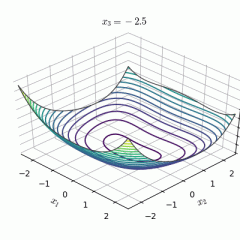
Rosenbrock function
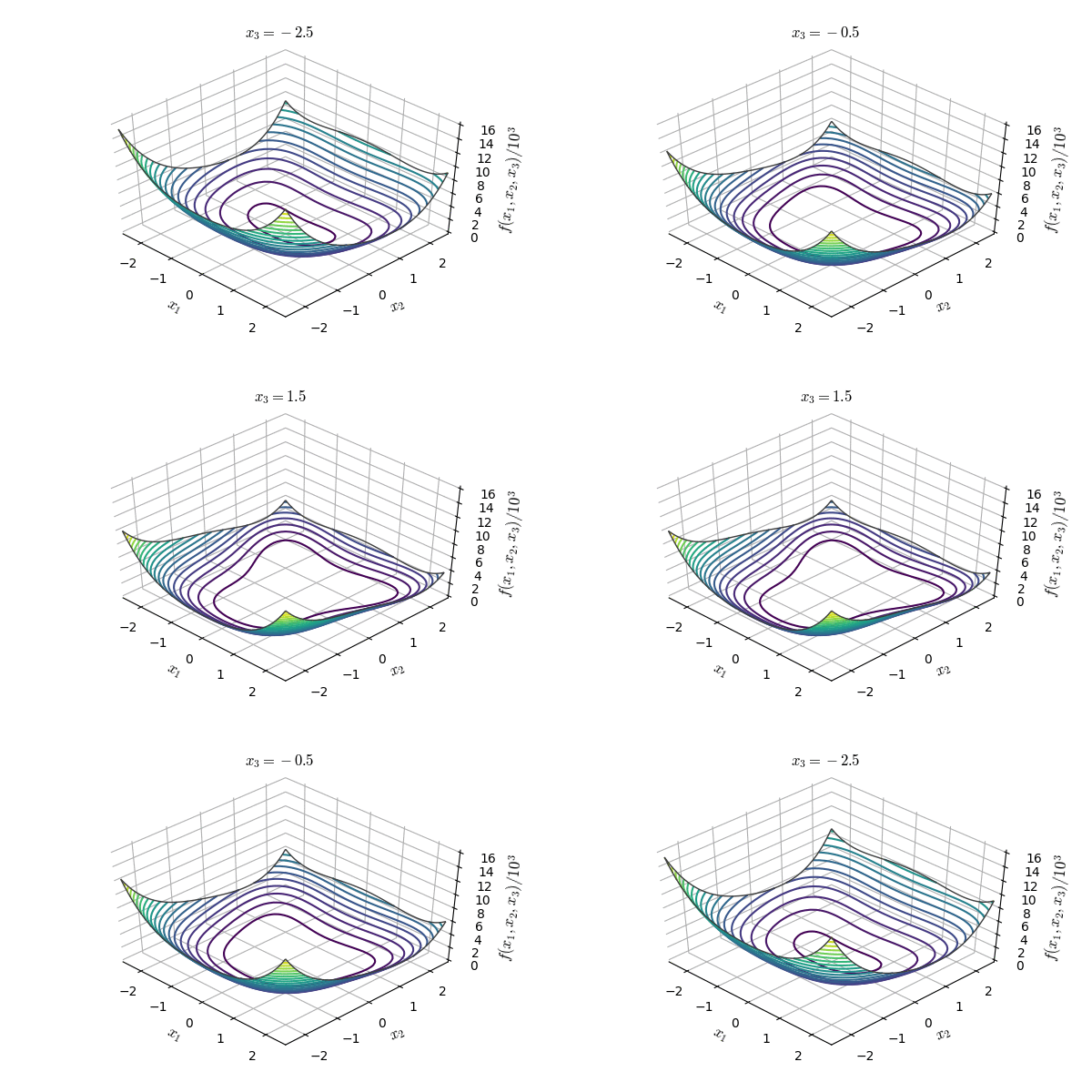
In mathematical optimization, the Rosenbrock function is really a non-convex function, created by Howard H. Rosenbrock in 1960, which is often used like a performance test problem for optimization algorithms. It’s also referred to as Rosenbrock’s valley or Rosenbrock’s blueberry function.
The worldwide minimum is in the lengthy, narrow, parabolic formed flat valley. To obtain the valley is trivial. To converge towards the global minimum, however, is tough.
The part is determined by
f
(
x
,
y
)
=
(
a
−
x
)
2
+
b
(
y
−
x
2
)
2
+b(y-x^)^
It features a global minimum at
(
x
,
y
)
=
(
a
,
a
2
)
)
, where
f
(
x
,
y
)
=
. These parameters are positioned so that
a
=
1
and
b
=
100
. Only within the trivial situation where
a
=
the part is symmetric and also the minimum reaches the foundation.
Two variants are generally experienced.
The first is the sum of the
N
/
2
uncoupled 2D Rosenbrock problems, and it is defined just for even
N
s:
This variant has predictably simple solutions.
Another, more involved variant is
has exactly one minimum for
N
=
3
(at
(
1
,
1
,
1
)
) and just two minima for
4
≤
N
≤
7
—the global the least all ones along with a local minimum near
(
x
1
,
x
2
,
…
,
x
N
)
=
(
−
1
,
1
,
…
,
1
)
,x_,dots ,x_)=(-1,1,dots ,1)
. This outcome is acquired by setting the gradient from the function comparable to zero, realizing the resulting equation is really a rational purpose of
x
. For small
N
the polynomials can be established exactly and Sturm’s theorem may be used to determine the amount of real roots, as the roots could be bounded around
x
i
<
2.4
x_
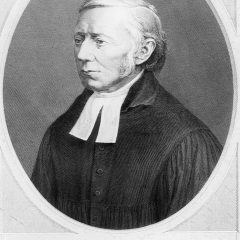
Theodor Fliedner

Image by/from
Theodor Fliedner (21 The month of january 1800 – 4 October 1864) would be a German Lutheran minister and founding father of Lutheran deaconess training. In 1836, he founded Kaiserswerther Diakonie, a medical facility and deaconess training center. He’s commemorated like a renewer of society within the Calendar of Saints from the Evangelical Lutheran Church in the usa on October 4 by the Evangelical Church in Germany on October fifth.
Fliedner was created in Eppstein in Hesse, Germany. He was the boy of the Lutheran minister. Pastor Fliedner studied theology at College of Giessen and also the College of Gottingen in addition to at Herborn Academy, the theological seminary in Herborn. He was for some time, a home teacher. In 1821 he assumed the pastorate within the poor town of Kaiserswerth (now in Dusseldorf). Once the town could no more support church and ministry because of a fiscal crisis, he began journeys to gather donations. Starting in Westphalia, also, he visited holland and England.
Within the Indies he grew to become knowledgeable about the traditional church office of deaconess while spending some time one of the Moravian Church, which in fact had elevated the institution in 1745. In England he met with British social reformer, Elizabeth Fry, who shown her work among her nation’s impoverished and imprisoned people. He came back home not just having a large financial collection for his town but additionally with new ideas about social work one of the disadvantaged. He started by working among inmates in the Dusseldorf Prison, preaching the Gospel and ministering to spiritual and physical needs. He walked back and forth from Dusseldorf almost every other Sunday until a normal prison chaplain was hired. The German prisons were then in an exceedingly bad condition but individuals thinking about their improvement banded together, as well as in 1826, Fliedner produced the Rhenish-Westphalian Prison Society (Rheinisch-Westfalische Gefangnisgesellschaft). Fliedner recognized that the initial step should be toward searching following the prisoners on their own release, and accordingly, in 1833, he opened up at Kaiserswerth a refuge for discharged female convicts. To higher support and educate Kaiserwerth’s children, he founded a college in 1835 which grew to become the venue for any women teachers’ seminar.
In lots of metropolitan areas, there have been no hospitals in those days. Following somewhat the type of the first Christian Church’s diaconate, incorporating ideas learned from Fry and also the Mennonites, and applying their own ideas, Fliedner created a plan whereby youthful women would find and look after the needy sick. With this, he required to create Kaiserswerther Diakonie, an institute where women could learn both theology and nursing skills. He opened up a healthcare facility and deaconess training center in Kaiserswerth on 13 October 1836. Gertrud Reichardt was the very first deaconess commissioned through the new school. Florence Nightingale trained there like a nurse in 1850. Among the connected Kaiserwerth professional schools was later named in her own recognition. Another noted student was the Swedish Maria Cederschiold, an innovator of nursing in her own country.
After his wife, Friederike, died in 1842, he found a brand new existence companion (and important worker) in Caroline Bertheau. They opened up institutes for that diaconate in 1844 in Dortmund as well as in 1847 in Berlin using the support of King Ernest William IV of Prussia, and the wife Queen Elizabeth. Fliedner’s attention grew to become completely centered on this part of the ministry as well as in 1849 he switched completely to dealing with the diaconate, including growing activity abroad. Fliedner’s movement continues to be reported because the model for that Inner Mission movement which Johann Hinrich Wichern developed.
Due to these efforts, deaconess institutes came about in Paris, Oslo, Strasbourg, Utrecht, and elsewhere. When of his dying in 1864, there have been 30 motherhouses and 1,600 deaconesses worldwide. By the center of the twentieth century, there have been over 35,000 deaconesses serving in parishes, schools, hospitals, and prisons around the world.
An indication of the worldwide respect Fliedner received is the fact that his most well-known pupil originated from outdoors Germany. British nursing reformer Florence Nightingale first visited in 1841. She was astounded by the religious devotion and noted the majority of the deaconesses were of peasant origin. She finished the ability in 1851. Today, certainly one of Dusseldorf’s hospitals (Florence-Nightingale-Krankenhaus) bears her name.
This short article incorporates reference material from Theodor Fliedner Encyclopadia Britannica (Chisholm, Hugh, erectile dysfunction. eleventh erectile dysfunction. 1911 Cambridge College Press)
Symbolic interactionism
Symbolic interactionism is really a sociological theory that develops from practical factors and alludes to people’s particular usage of dialect to create images and normal implications, for deduction and correspondence with other people. Quite simply, it’s a frame of mention of the better know how individuals communicate with each other to produce symbolic worlds, as well as in return, how these worlds shape individual behaviors. It’s a framework that can help know how society is preserved and produced through repeated interactions between individuals. The interpretation procedure that occurs between interactions help create and recreate meaning. It’s the shared understanding and interpretations of and therefore modify the interaction between individuals. Individuals act upon the idea of the shared knowledge of meaning inside their social context. Thus, interaction and behavior is presented with the shared and therefore objects and ideas have mounted on them. Out of this view, people reside in both natural and symbolic environments.
Symbolic interactionism develops from a sociological perspective which developed around the center of the 20th century and that is still influential in certain regions of the discipline. It’s particularly significant in microsociology and social psychology. It comes from the American philosophy of pragmatism especially in the work of George Herbert Mead, like a practical approach to interpret social interactions.
R. Collins views symbolic interactionism as studying how a social world is produced through interaction between individuals as well as their atmosphere.
Symbolic interaction was created by George Herbert Mead and Charles Horton Cooley. Mead contended that people’s selves are social products, however that these selves will also be purposive and inventive, and thought that the real test associated with a theory was it had become “helpful in solving complex social problems”. Mead’s influence was stated to become so effective that sociologists regard him because the one “true founder” from the symbolic interactionism tradition. Although Mead trained inside a philosophy department, he’s most widely known by sociologists because the teacher who trained an era of the greatest minds within their field. Oddly, he never established his wide-varying ideas inside a book or systematic treatise. After his dying in 1931, his students pulled together class notes and conversations using their mentor and printed Mind, Self and Society in the name. It’s a common misconception that John Dewey was the best choice of the sociological theory based on the Guide of Symbolic Interactionism, Mead was unquestionably the person who “transformed the interior structure from the theory, moving it to some greater degree of theoretical complexity”. Mind, Self and Society may be the book printed by Mead’s students according to his lectures and teaching, and also the title from the book highlights the main idea of social interactionism. Mind describes a person’s capability to use symbols to produce meanings for that world round the individual – individuals use language and thought to achieve this goal. Self describes a person’s capability to reflect in route the person is perceived by others. Finally, society, based on Mead, is how many of these interactions take place. An over-all description of Mead’s compositions portray how outdoors social structures, classes, and power and abuse modify the growth of self, personality for gatherings verifiably denied of the opportunity to characterize themselves.
Herbert Blumer, students and interpreter of Mead, created the word and set forward an important summary: people act in a certain style towards things in line with the meaning individuals things curently have, which meanings come from social interaction and modified through interpretation. Blumer would be a social constructionist, and it was affected by John Dewey as a result, this theory is extremely phenomenologically-based. Considering that Blumer was the first one to use symbolic interaction like a term, he is called the founding father of symbolic interaction. He thought that the “Most human and humanizing activity that individuals participate in is speaking to one another.” Based on Blumer, human groups are produced by individuals which is only actions together that comprise a society. He contended by using interaction and thru interaction individuals can “produce common symbols by approving, organizing, and redefining them.” Getting stated that, interaction is formed with a mutual exchange of interpretation, the floor of socialization.
While getting less influential operate in the discipline, Charles Horton Cooley and William Isaac Thomas are regarded as influential representatives from the theory. Cooley’s focus on connecting society and also the individuals influenced Mead’s further workings. Cooley felt society and also the individuals could simply be understood in relationship to one another. Cooley’s idea of the “looking-glass self”, influenced George Herbert Mead’s theory of self and symbolic interactionism. William Isaac Thomas is also referred to as an agent of symbolic interactionism. His primary work would be a theory of human motivation addressing interactions between individuals and also the “social causes of behaviors.” He tried to “explain the correct methodological method of social existence create a theory of human motivation show a functional conception of adult socialization and supply the right perspective on deviance and disorganization.” Most scholars accept Thomas.
Two other theorists who’ve influenced symbolic interaction theory are Yrjo Engestrom and David Middleton. Engestrom and Middleton described the effectiveness of symbolic interactionism within the communication field in a number of work settings, including “courts of law, healthcare, software applications design, scientific laboratory, telephone sales, control, repair, and upkeep of advanced manufacturing systems”. Other scholars credited for his or her contribution towards the theory are Thomas, Park, James, Horton Cooley, Znaniecki, Baldwin, Redfield, and Wirth. Unlike other social sciences, symbolic interactionism emphasizes greatly around the ideas of action rather of culture, class and power. Based on behaviorism, Darwinism, pragmatism, in addition to Max Weber, action theory contributed considerably towards the formation of social interactionism like a theoretical perspective in communication studies.
Most symbolic interactionists believe an actual reality truly does exist by a person’s social definitions, which social definitions do develop partly or with regards to something “real”. People thus don’t react to this reality directly, but instead towards the social knowledge of reality i.e., they react to this reality not directly through a type of filter featuring its individuals’ different perspectives. Which means that humans exist away from the physical space made up of realities, however in the “world” composed only of “objects”.
Three assumptions frame symbolic interactionism:
Getting defined a few of the underlying assumptions of symbolic interactionism, it’s important to deal with the premises that every assumption supports. Based on Blumer, you will find three premises that may be produced from the assumptions above.
Premise 1: “Humans act toward things based on the meanings they ascribe to individuals things.”
The very first premise includes exactly what a person may note within their world, including physical objects, actions and ideas. Basically, individuals behave towards objects yet others in line with the personal meanings the individual has given these products. Blumer was attempting to put focus on this is behind individual behaviors, particularly speaking, mental and sociological explanations for individuals actions and behaviors.
Premise 2: “This is of these things comes from, or arises from, the social interaction that certain has with other people and also the society.”
The 2nd premise explains this is of these things comes from, or arises from, the social interaction that certain has along with other humans. Blumer, following Mead, claimed people communicate with one another by interpreting or defining each other peoples actions rather of just reacting to every other peoples actions. Their “response” isn’t made straight to those things of each other but rather is dependant on this is that they affix to such actions. Thus, human interaction is mediated through symbols and signification, by interpretation, or by ascertaining this is of 1 another’s actions. Meaning is either overlooked and pressed aside being an trivial element which require to not be investigated, or it’s considered like a mere neutral link or among the causal chains between your causes or factors accountable for human behavior which behavior because the product of these factors.
Premise 3: “The Meanings are handled in, and modified through, an interpretative process used by the pack leader in working with the items he/she encounters.”
Symbolic interactionists describe thinking being an inner conversation. Mead known as this inner dialogue minding, the delay in a person’s way of thinking that occurs when one considers the things they is going to do next. These meanings are handled in, and modified through, an interpretive process used by the pack leader in working with the items he encounters. We naturally speak with ourselves to be able to straighten out this is of the difficult situation. However, we want language. Before we are able to think, we have to have the ability to interact symbolically. The focus on symbols, negotiated meaning, and social construction of society introduced focus on the roles people play. Role-taking is really a key mechanism that enables individuals to see someone else’s perspective to understand an action might mean to a different person. Role-taking is part of our way of life while very young, for example, playing house and pretending to become another person. There’s an improvisational quality to roles however, actors frequently undertake a script they follow. Due to the uncertainty of roles in social contexts, the responsibility of role-making is from case to case within the situation. Within this sense, we’re positive participants within our atmosphere.
Nearly all interactionist research uses qualitative research methods, like participant observation, to review facets of social interaction, and/or individuals’ selves. Participant observation enables researchers to gain access to symbols and meanings, as with Howard S. Becker’s Art Worlds and Arlie Hochschild’s The Managed Heart. They reason that close contact and immersion within the everyday activity from the participants is essential for comprehending the concept of actions, defining situations and also the procedure that actors construct the problem through their interaction. Due to this close contact, interactions cannot remain completely liberated of worth commitments. Generally, they utilize their values in selecting things to study however, they aim to be objective in the way they conduct the study. Therefore, the symbolic-interaction approach is really a micro-level orientation concentrating on human interaction in certain situations.
You will find five central suggestions to symbolic interactionism based on Joel M. Charon, author of Symbolic Interactionism An Intro, An Interpretation, An Integration:
To Blumer’s conceptual perspective, he insert them in three core propositions: that individuals act toward things, including one another, based on the meanings they’ve on their behalf these meanings are derived through social interaction with other people which these meanings are managed and transformed with an interpretive procedure that people use to understand and take care of the objects that constitute their social worlds. This angle may also be referred to as three core concepts- Meaning, Language and Thinking- by which social constructs are created. The key of meaning is the middle of human behavior. Language provides meaning by supplying way to symbols. These symbols differentiate social relations of humans from those of creatures. By humans giving intending to symbols, they are able to express this stuff with language. Consequently, symbols make up the foundation of communication. Symbols become imperative components for that formation of any sort of communicative act. Thinking then changes the interpretation of people when it comes to symbols.
Keeping Blumer’s earlier operate in mind David A. Snow, professor of sociology in the College of California, Irvine, suggests four broader and much more fundamental orienting concepts: human agency, interactive determination, symbolization, and emergence. Snow uses these four concepts because the thematic bases for identifying and discussing contributions to study regarding social movements.
Human agency emphasizes the active, willful, goal-seeking character of human actors. The focus on agency focuses attention on individuals actions, occasions, and moments in social existence by which agentic action is particularly palpable.
Interactive determination specifies that knowledge of focal objects of research, whether or not they are self-concepts, identities, roles, practices, or perhaps social movements. Essentially what this means is, neither individual, society, self, varieties exist only with regards to one another and for that reason could be fully understood only when it comes to their interaction.
Symbolization highlights the processes by which occasions and types of conditions, artifacts, people, along with other ecological features that undertake particular meanings, becoming nearly only objects of orientation. Human behavior is partially determined by exactly what the object of orientation symbolizes or means.
Emergence concentrates on attention around the processual and non-habituated side of social existence, focusing not just on organization and texture of social existence, but additionally connected meaning and feelings. The main of emergence informs us not just to chance of new types of social existence and system meaning but additionally to transformations in existing types of social organization.
Symbolic interaction may be used to explain a person’s identity when it comes to roles being “ideas and concepts on ‘what to do’ inside a given situation,” as noted by Hewitt. Symbolic Interactionist identity presents in 3 groups- situated, personal and social. Situated identity refers back to the capability to view themselves as others do. This really is frequently an overview view in that it’s short, but can be quite impactful. Out of this experience, one desires to differentiate themselves from others and also the personal identity involves exist. This view happens when one desires to make themselves noted for who they really are, and not the look at others. In the personal identity happening, comes the social identity where connections and likeness are created with folks discussing similar identities or identity traits.
This point of view of symbolic interactionism does apply to using social networks and just how a person’s identity is presented on individuals sites. With social networks, it’s possible to boast (or publish) their identity through their newsfeed. The private identity comes up in the requirement for visitors to publish milestones that certain has achieved, in efforts to distinguish themselves. The social identity comes up when folks “tag” others within their posts, pictures, etc. Situated identities may trouble the necessity to defend something on social networking or arguments that exist in comments, where one feels it essential to “prove” themselves.
From the point of view that people learn, or at best desire, how you can expect other’s reactions/responses to things, Bruce Link and the colleagues studied how expectations from the reactions of others can impact the mental illness stigma. The participants from the study were people with psychosis who clarified questions associated with discrimination, stigma, and rejection. The aim of the research ended up being to see whether others’ expectations modify the participants’ internalized stigmas, anticipated rejection, concerns with remaining in, along with other. Results discovered that high amounts of internalized stigma were only contained in the minority, however, anticipation of rejection, stigma awareness, perceived devaluation discrimination and concerns with remaining in were discovered to be more widespread in participants. These perceptions were correlated using the connection between withdrawal, self-esteem and isolation from relatives. The research discovered that anticipation of rejection performed the biggest role in internalized stigmas.New media is really a expression used to define everything relates to the web and also the interplay between technology, images and seem. As studies of internet community proliferate, the idea of network has turned into a more recognized social construct. Studies encompassed discursive communities identity community as social reality networking the general public sphere ease and anonymity in interactions. These research has shown that network is a vital social construct when it comes to its cultural, structural, economic and political character.
It’s been shown that people’s ideas about community are created, partly, through interactions in online forums and face-to-face. Consequently, people act within their communities based on the meanings they derive regarding their atmosphere, whether offline or online, from individuals interactions. This angle reveals that online communication might easily undertake different meanings for various people based on information, circumstance, relationships, power, along with other systems that comprise communities of practice. People enact community the actual way it is created and also the concept of community evolves because they develop new methods to put it to use. With all this reality, scholars are constantly challenged to analyze and know how social networks consist, the way they function, and just how they’re linked to offline social existence.
Symbolic interaction theory was discussed within the Cyberself: The Self-ing Project goes online, Symbolic Interaction within the Digital Age. Laura Robinson discusses how symbolic interaction theory explains the way in which individuals create a feeling of self through their interactions with other people. However, she believes advances in technology have altered this. The content investigates the way individuals form their online identity. She uses symbolic interaction theory to look at the development from the cyber “I” along with a digital “generalized other”. Within the article, Robinson suggests individuals form new identities on the web. She argues these cyber identities aren’t always how a individual could be perceived offline.
Symbolic interactionists are frequently belittled to be excessively impressionistic within their research methods and somewhat unsystematic within their theories. It’s contended the theory isn’t one theory, but instead, the framework for a lot of different theories. Furthermore, some theorists have trouble with symbolic interaction theory because of its insufficient testability. These objections, combined with fairly narrow focus of interactionist research on small-group interactions along with other social mental issues, have relegated the interactionist camp to some minority position among sociologists (although a reasonably substantial minority). Point about this critique came about throughout the 1970s within the U.S. when quantitative methods to sociology were dominant. Possibly the very best known could well be by Alvin Gouldner.
Some critiques of symbolic interactionism derive from the idea that it’s a theory, and also the critiques use the criteria for any “good” theory to something that doesn’t tell you they are an idea. Some critics discover the symbolic interactionist framework too broad and general when they’re seeking specific theories. Symbolic interactionism is really a theoretical framework as opposed to a theory and could be assessed based on effective conceptualizations. The theoretical framework, just like any theoretical framework, is vague with regards to analyzing empirical data or predicting outcomes in social existence. Like a framework as opposed to a theory, many scholars find it hard to use. Interactionism as being a framework as opposed to a theory causes it to be impossible to check interactionism in the way that the specific theoretical claim concerning the relationship between specific variables inside a given context enables. Unlike the symbolic interactionist framework, the numerous theories produced from symbolic interactionism, for example role theory and also the versions of identity theory produced by Sheldon Stryker, and Peter Burke and colleagues, define concepts and also the relationships between these questions given context, thus permitting the chance to build up and test ideas. Further, especially among Blumerian processual interactionists, a lot of very helpful conceptualizations happen to be developed and applied in an exceedingly number of social contexts, kinds of populations, kinds of behaviors, and cultures and subcultures.
Symbolic interactionism is frequently related and associated with social structure. This idea shows that symbolic interactionism is really a construction of people’s social reality. Additionally, it signifies that from the realistic perspective, the interpretations which are being made won’t make much difference. When a realistic look at a scenario is determined, the problem turns into a significant reality. Including methodological criticisms, and demanding sociological issues. Numerous symbolic interactionists have addressed these topics, the very best known being Stryker’s structural symbolic interactionism and also the formulations of interactionism heavily affected by this method (sometimes known as the “Indiana School” of symbolic interactionism), such as the works of key scholars in sociology and psychology using different ways and theories applying a structural form of interactionism which are symbolized inside a 2003 collection edited by Burke et al. Another well-known structural variation of symbolic interactionism that applies quantitative methods is Manford H. Kuhn’s formulation that is frequently known in sociological literature because the “Iowa School”. “Negotiated order theory” will also apply a structural approach.
Language can be regarded as the origin of meaning. Blumer illuminates several key features about social interactionism. Many people interpret things according to assignment and purpose. The interaction occurs when the concept of something is becoming identified. This idea of meaning is exactly what begins to construct the framework of social reality. By aligning social reality, Blumer shows that language may be the concept of interaction. Communication, especially by means of symbolic interactionism is associated with language. Language initiates all types of communication, verbal and non-verbal. Blumer defines this supply of meaning like a connection that arises from the social interaction that individuals have with one another.
Based on social theorist Patricia Burbank, the concepts of synergistic and diverging qualities are what shape the viewpoints of humans as social beings. Both of these concepts will vary in this way due to their views of human freedom as well as their degree of focus. Based on Burbank, actions derive from the results of situations that occur along the way of social interaction. Another essential element in significant situations may be the atmosphere where the social interaction occurs. The atmosphere influences interaction, which results in a reference group and connects with perspective, after which concludes to some meaning of the problem. This illustrates the correct steps to define a scenario. An agreement from the action occurs once everything is defined. An interpretation will be made upon that action, which might ultimately influence the angle, action, and definition.
Stryker emphasizes the sociology world in particular is easily the most viable and vibrant intellectual framework. When you are comprised of our ideas and self-belief, the social interactionism theory is the objective of all human interaction, and it is what can cause society to exist. This fuels criticisms from the symbolic interactionist framework for neglecting to take into account social structure, in addition to criticisms that interactionist theories can’t be assessed via quantitative methods, and can’t be falsifiable or tested empirically. Framework is essential for that symbolic interaction theory because for to ensure that the social structure to create, there are specific bonds of communication that should be created produce the interaction. A lot of the symbolic interactionist framework’s fundamental tenets are available in a really number of sociological and mental work, without having to be clearly reported as interactionist, making the influence of symbolic interactionism hard to recognize with all this general acceptance of their assumptions as “common understanding”.
One other issue with this particular model is 2-fold 1) not considering human feelings greatly and a pair of) getting thinking about social structure to some limited extent. The very first, signifies that symbolic interaction isn’t completely mental. The 2nd, signifies that symbolic interaction isn’t completely sociological. These incompetencies picture meaning as something naturally sourced inside an interaction within certain condition, instead of taking into consideration the fundamental social context by which interaction lies. Out of this view, meaning doesn’t have source and doesn’t see a social reality beyond what humans create using their own interpretations.
Another critique of symbolic interactionism is much more the like students themselves. They’re noted not to be interested within the good reputation for this sociological approach. This is able to produce shallow understanding and may result in the subject “difficult to educate” in line with the insufficient organization in the teachings to correspond with other theories or studies.
The Society for study regarding Symbolic Interaction (SSSI) is definitely an worldwide professional organization for scholars, who are curious about study regarding symbolic interaction. SSSI holds a celebration with the meeting from the American Sociological Association and also the Society for study regarding Social Problems. This conference typically happens in August and sponsors the Society for study regarding Symbolic Interaction supports the Couch-Stone Symposium each spring. The society provides travel scholarships for student people thinking about attending the annual conference. In the annual conference, the Society for study regarding Symbolic Interaction sponsors yearly awards in various groups of symbolic interaction. Furthermore, a few of the awards are available to student people from the society. The Ellis-Bochner Autoethnography and private Narrative Research Award is offered yearly through the Society for study regarding Symbolic Interaction affiliate from the National Communication Association to find the best article, essay, or book chapter in autoethnography and private narrative research. The award is known as after famous autoethnographers Carolyn Ellis and Art Bochner. The society also sponsors an every three months journal, Symbolic Interaction. The business also releases a e-newsletter, SSSI Notes.
Society for study regarding Symbolic Interaction has additionally the ecu branch. It organizes every year the conference that integrates European symbolic interactionists.
39.Carter, M. J., & Larger, C. (2015). Symbolic interactionism. Sociopedia. doi:10.1177/205684601561
40. Handberg, Charlotte now, et al. “Revisiting Symbolic Interactionism like a Theoretical Framework Past the Grounded Theory Tradition.” Qualitative Health Research, vol. 25, no. 8, August. 2015, pp. 1023-1032, doi:10.1177/1049732314554231.
MeadWestvaco
MeadWestvaco Corporation was a united states packaging company located in Richmond, Virginia. It’d roughly 23,000 employees. In Feb 2006, it moved its corporate headquarters to Richmond. In March 2008, the organization announced a big change to begin using “MWV” since it’s brand, however the legal name of the organization remains MeadWestvaco.
MeadWestvaco announced in The month of january 2015 it would form a combined $16 billion company with RockTenn to defend myself against management within the packaging industry within the U.S. The brand new clients are entitled WestRock.
MeadWestvaco would be a producer of packaging, niche papers, consumer and office products and niche chemicals. The organization had 153 operating and office locations in 30 countries, and serves customers in over 100 countries. The business’s paperboard, package and paper brands incorporated Carrier Kote, Custom Kote, Printkote, Tango, Digipak, Amaray, Dosepak and Vision. MeadWestvaco held leading positions within the markets it offered. MeadWestvaco managed over 3 million acres (12,000 km²) of forestlands meeting stringent ecological standards and licensed to Sustainable Forestry Initiative standards.
MeadWestvaco was created in The month of january 2002 because of a merger between your Mead Corporation of Dayton, Ohio, and Westvaco (initially the Piedmont Pulp and Paper Company and so the West Virginia Pulp and Paper Company).
The ancestor from the Mead Paper Company began in the paper business in 1846 but didn’t adopt the name Mead until 1882. Within the decades, Mead diversified into a variety of companies and economic sectors, through purchases, mergers and joint ventures. It was initially on the New You are able to Stock Market in 1935. In 1966, Mead acquired Westab, whose products incorporated the large Chief tablet, Spiral Notebook logo and Hytone Notebooks.
In 1968, Mead joined the data technology sector by obtaining small businesses known as Data Corporation for $six million, and renamed it Mead Data Central. Mead was initially thinking about an inkjet printing system produced by Data. However, Data had been focusing on a complete-text information retrieval system for that U.S. Air Pressure, by 1967 had adapted the product towards the task of indexing and looking out legal precedent included in a test using the Ohio Condition Bar. After an Arthur D. Little study established that the data retrieval product were built with a promising future, Mead Data Central launched it as being the LEXIS legal research system in 1973. In December 1994, Mead offered the LexisNexis system to Reed Elsevier for $1.5 billion.
The U.S. condition of Illinois subsequently audited Mead’s tax returns and billed Mead yet another $4 million in tax and penalties for that purchase of LexisNexis Mead compensated the tax under protest, then accused of reimbursement within an Illinois condition court. On April 15, 2008, the U.S. Top Court agreed with Mead the Illinois courts had incorrectly applied the Court’s precedents on whether Illinois could constitutionally apply its tax to Mead, an out-of-condition, Ohio-based corporation. A Legal Court reversed and remanded so the lower courts could use the correct make sure see whether Mead and Lexis were a “unitary” business.
In 1986, Mead acquired Ampad makers of legal pads so it offered in 1992 to Bain Capital.
Mead acquired the Hilroy Companies in 1994 from the consortium of banks which had purchased Olympia and You are able to in the receiver, O&Y’s subsidiary through Abitibi-Cost.
In 2005, the Papers business unit—including both Mead and Westvaco paper mills—was offered towards the investment firm Cerberus Capital Management for around $2.3 billion. The brand new clients are known as NewPage Corporation, which operated from Dayton, Ohio for some time until it outgrew its facilities. NewPage is presently headquartered in Miamisburg, Ohio.
In 2008, MeadWestvaco offered its Charleston, SC kraft paper mill to Kapstone Paper and Packaging.
MeadWestvaco started while using “MWV” brand in 2008.
In Feb 2011, MeadWestvaco offered its Envelope Products Business such as the Columbian Brand Envelope to Cenveo Corporation’s Quality Park Envelope Products Group.
This Year, ACCO Brands acquired the customer and office products companies, including Mead, 5 Star, AT-A-GLANCE, Cambridge, Day Runner, Hilroy, Tilibra, and Grafons.
In 2002, researchers in the College of Massachusetts Amherst have identified MeadWestvaco because the 57th-largest corporate producer of polluting of the environment within the U . s . States, with roughly 35,000 pounds of toxic chemicals released yearly in to the air. Major pollutants shown by the research include sulfuric acidity, swimming pool water dioxide, swimming pool water, and methyl iodide.
MWV required steps to enhance its ecological impact by upholding both mandated and voluntary performance standards. It had been incorporated within the Dow jones Johnson Sustainability World Index, a method that tracks the financial performance of leading sustainability-driven companies worldwide. MWV met the carbon reduction targets from the Chicago Climate Exchange (CCX), the earth’s first and North America’s only legally binding rules-based green house gas emissions allowance buying and selling system. It held leadership positions in and positively supports Sustainable Packaging Coalition, Cerflor, CCX, World Business Council for Sustainable Development, Abundant Forests Alliance, Duke College Global Warming Policy Partnership and Sustainable Forestry Initiative.
In 2002, MeadWestvaco established the MeadWestvaco Foundation like a vehicle to appropriately hand back towards the communities by which its employees live and work. The Building Blocks works carefully with local MWV business unit managers to look for the goals, priorities, and techniques perfect for each location.
The Foundation’s 2007 contributions totaled roughly $3.7million. Funds were allotted towards the following groups: U . s . Way, education, atmosphere, health & human services, culture & art, and social organizations. MWV employees, families, and buddies also contributed over 46,000 volunteer hrs to colleges, charitable organizations, and public institutions.
Waterloo Road (series 6)
The sixth number of the British television drama series Waterloo Road started broadcasting on 1 September 2010, and ended on 6 April 2011 on BBC One. The series follows the lives from the faculty and pupils from the Eponymous school, a failing inner-city comprehensive school. It includes twenty episodes, split into two half number of ten episodes each. The sixth series achieved typically 5.11 million viewers within the ratings.[N 1]
The appearance of dynamic new mind teacher Karen Fisher heralds a brand new start for that school. Opinionated and ambitious, Karen is decided to create change, making Waterloo Road a secure and vibrant spot to learn. However, Karen’s steely exterior masks a much deeper fragility as she and her family wrestle having a recent tragedy. Karen’s first challenge in the school arrives by means of the Kirbys – sixth-former Jonah and 13-year-old genius Ruth – who’ve both been home-schooled by their father, Marcus. Marcus’s ex-wife, Hannah, wants her children to see mainstream schooling, but he’s little belief within the condition education system. While Jonah relishes the chance to create new buddies and also have new encounters, high-achiever Ruth feels she gets little to understand and shortly takes matters into her very own hands by running away. Meanwhile, Chris has rested having a girl known as Jess, however when he gets to the college he’s horrified to understand that she’s not just a Sixth Form student but Karen’s daughter.
Cesca is attracted right into a complicated situation that threatens to finish her career. Meanwhile, Grantly’s more and more slovenly conduct causes concern for Ruby, who’s facing her very own problems by means of Janeece and John’s blossoming friendship. Cesca’s honest approach in her own drugs-awareness class backfires when Sambuca involves her requesting money to purchase drugs. Sam’s intentions are great, however she would like to purchase the drugs from Amy and Lauren after which discard them to be able to safeguard her buddies. The ever-manipulative Amy does not trust Mike and hatches a more sophisticated intend to frame her. Facing exclusion, Mike depends on the honesty of her closest friend, Lauren, while Cesca’s status is based on tatters as Karen struggles to solve the reality.
When Chris launches an effort plan to equip the classrooms with Closed-circuit television there’s uproar among both staff and pupils. Jonah is outraged as he learns the staff room does not possess a camera and, together with Ronan, hatches an agenda to reveal the hypocrisy from the plan, unwittingly stumbling upon Jess’s and Chris’s secret along the way. In awe of his discovery, he quickly hurts a bewildered Jess before launching themself at Chris in the center of the corridor. Because the pair anxiously try to hide the reality from Karen, Chris realises he or she must stop running in the truth. As Karen is confronted with an enormous decision, Marcus Kirby offers a shocking further ultimatum to her. What’s going to Karen do? Elsewhere, through the assistance of Jonah and Ronan’s grown Closed-circuit television camera within the staff room, Grantly’s shocking home existence is uncovered towards the year 11s, who taunt him about this at school, and push him to his wits finish. Eager for help, he seeks the use of a former friend, and should decide where Fleur’s future lies.
It is the final day’s term, having a charitable organization fundraising event inspiring pupils into unique ideas. Grantly and Steph take Fleur to go to the things they hope is going to be her new care home. However, instructions in the council to Grantly informs him that Fleur doesn’t be eligible for a any kind of pension, and therefore he or she must spend the money for full quantity of her care, a charge that could leave him broke. Further anguish for Grantly awaits him in the school when Ruth Kirby, upon sitting an British A-Level mock, finds out that they and all of those other A-Level students, happen to be trained the books looking for the prior years exams, and also have no understanding of the present years set texts. The large mistake Grantly leave his career hanging with a thread. Elsewhere, Charlie breaks some not so good news upon Jess and Harry, further fuelling dislike in the pair, along with a face from Karen’s past returns.
The brand new term begins at Waterloo Road with new arrivals for staff and students. As a result of the boys’ poor exam grades, Karen and Chris introduce a brand new single-sex teaching initiative, much towards the disdain of staff and pupils. Especially unimpressed may be the formidable new Mind of Pastoral Care, Adanna Lawal, who rallies all of those other staffroom into action from the segregation. New boy Kyle Stack (George Sampson) gets to the college, filled with mother and Rottweiler, Manic. Kyle’s first action at Waterloo Road is really a violent clash with Finn Sharkey, leading him towards the cooler. Inside, he meets Bex and, although concerned at her distress, attempts to comfort her, simply to have her make allegations of sexual assault from him to Karen and Chris. As a result of this, Kyle pushes the limitations and demands Bex be truthful. What lengths will Kyle go? Meanwhile, Ruby asks Janeece to become her classroom assistant as a result of her continuous failure to manage the pupils conduct.
Harry’s cry for attention veers unmanageable as he steals Karen’s phone and results in turmoil among the employees of Waterloo Road. Meanwhile, Chris and Karen get their hands full using the school business initiative contest and Tom struggles to readjust throughout his first day back. When Karen and Harry arrived at blows over his falling grades, a disgruntled Harry will get his revenge by causing mischief with Karen’s phone, delivering incendiary emails to another staff within the guise of his mother. As prevalent anger and paranoia spread with the school, Karen is confronted with an unpredicted staffroom revolt. Sambuca Kelly returns towards the school.
The secrecy surrounding Cesca’s relationship with Jonah is finally lifted when she hands in her own resignation to Karen. Elsewhere, Adanna unveils her latest intend to unite the sexes Denzil conducts a existence-threatening stunt and inventive variations threaten Ruby and Grantly’s writing partnership. Inside a bid to finally go public together with her relationship with Jonah, Cesca hands her notice in a shocked Karen and Chris having a fabricated story about her father being sick. However, when a number of occasions arouses Chris’s accusations, he follows the happy couple and lastly uncovers the reality, delivering shockwaves through Waterloo Road and getting the wrath of both Karen and Marcus.
It is the day’s the Waterloo Road pantomime and there is drama both off and on-stage as Finn will get Kyle intentionally began the cast, Cesca and Jonah hurry to obtain married and Denzil’s latest stunt leads to tragedy. When Finn goads Kyle right into a fight, he will get Kyle began the cast and takes the key role themself – much to Sambuca’s disgust. The bickering continues between Finn and Sambuca and, because the script veers suddenly off target, Kyle and Denzil exact an explosive payback, delivering Adanna’s good intentions in smoke and causing possible fatality for Finn.
Three different box teams of the sixth series was launched. The very first ten instances of the series were released on 7 Feb 2011, and also the back ten episodes were released on 20 June 2011. All twenty episodes were later released together on 16 The month of january 2012. These were released having a “15” British Board of Film Classification (BBFC) certificate (meaning it’s unacceptable for viewing by individuals younger than fifteen years).
Taylor Mead’s Ass
Taylor Mead’s Ass is really a film by Andy Warhol featuring Taylor Mead, composed entirely of the shot of Mead’s bottom, and filmed in the Factory in 1964.
Based on Watson’s Factory Made: Warhol and also the Sixties, Taylor Mead had achieved a diploma of fame that “inspired a backlash.” An example would be a letter towards the editors in the Village Voice in August 1964 which were not impressed with “films concentrating on Taylor Mead’s ass for 2 hrs.” Mead responded inside a letter towards the publication that no such film was based in the archives, but “we’re rectifying this undersight.” 2 days later, Warhol shot the “60-minute opus that consisted entirely of Taylor Mead’s Ass,” where Mead first exhibits a number of movement, then seems to “shove a number of objects up his ass.” The show was Mead’s continue for Warhol “in excess of 3 years”, in the finish of 1964, “Mead felt tricked by Warhol because of not showing the show.”
The show was referred to as “70-six seriocomic minutes of the poet/actor’s bottom absorbing light, attention, debris” by Wayne Koestenbaum, in Art Forum. In the book, Andy Warhol, Koestenbaum writes “Looking at his cleft moon for 76 minutes, I start to understand its abstractions: high-contrast lighting conscripts the ass into as being a figure for whiteness itself, specially when the ass merges using the blank leader each and every reel’s finish. The bottom, observed in isolation, appear clearly double: two cheekbones, divided within the center with a dark line. The bottom’s double structure recalls Andy’s two-paneled works of art . . . “